Chinook Jargon Phrasebook
Kahta Mamook Kopa Chinook Wawa - How to speak Chinook
Kamloops Wawa Word List:
This is a list of basic Chinook Jargon words as
reproduced in Kamloops Wawa, a publication of the Oblate missionary
community in
British Columbia during the 1890s. This is not, as far as I can
tell, the same list as one in another edition of Kamloops Wawa, as
there
are some differences in spelling that I remember from the other
version.
This list is produced separately here from the rest of the Phrasebook
because
of the wide divergence in spelling and apparent prononciation from the
other versions of the lexicon, most of which were published in the
United
States. There are also some words included here which do not
appear
in the usual sources (Gibbs, Shaw, etc.).
The original version of this list as it appeared in
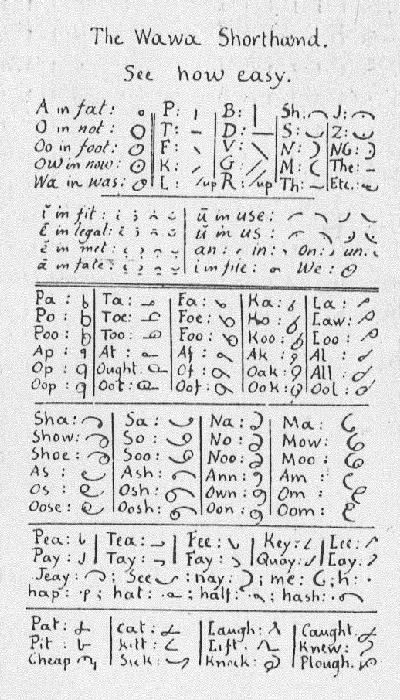
Kamloops Wawa included renderings of the words given in the Duployan
shorthand
script developed for the Jargon by Fr. Lejeune; there were apparently
at one time over 2000 people fluent in reading the Jargon in this
shorthand,
and many copies of the Kamloops Wawa are nearly entirely in the
shorthand
alone. The texts
in yellow are my own additions, consisting of the usual (or
alternate) spellings of the Jargon words noted, plus comments about
their
usual meanings and possible contexts; when necessary I have added links
to appropriate pages elsewhere in this site that are pertinent to the
word
cited. At the bottom of the word list there is some
editorializing
concerning the Jargon and the Duployan shorthand that was included in
the
same issue of the Kamloops Wawa as the word list, and for your
convenience
in studying the Duployan script glyphs of each word, the table of forms and
associated
phonemes may be viewed by clicking here (144kb). A
later revision of this page will attempt to align the glyphs according
to the baseline used in the original, which is too large of a GIF to be
viewed here in any legible format; many of the angle-lines shown here
are below this baseline.
NB: concerning prononciation, the final
"-e"
and "-ale" on most words should be understood to be a pronounced
syllable,
rather than a modifier of the preceding vowel as it is in
English.
e.g. the word poolale here is usually given in other Jargon
lexicons
as pollalie.
Current alphabetization is based on the spellings
as transliterated by LeJeune. Later improvements to these pages
will cross-reference the Kamloops Wawa spellings with the more common
Gibbs/Shaw system, and perhaps the new phonologically-strict
orthography of the Grand Ronde Creole. Note that some words are
placed alphabetically; e.g. "ice" is under 'A" because of the opening
vowel, unlike other i-words which have "ih" at the start.
Similarly, whip and wheat are in 'h" because LeJeune transcribed them
with the whispered-h pronuncation once proper in English..
 Aiak - Fast
hyak, hayak
Aiak - Fast
hyak, hayak
 Aias - Big hyas also means mighty,
important, etc.
Aias - Big hyas also means mighty,
important, etc.
 Aioo - Plenty
hiyu also means several, many, a group, a
gathering
Aioo - Plenty
hiyu also means several, many, a group, a
gathering
 Alta - Now the present
 Alke - By & by
alki the future; used to form the future
tense
Alke - By & by
alki the future; used to form the future
tense
 Ankate - Long ago ahnkuttie the past; used to form the past tense
 Ice
Ice
Y
 Yawa - There yahwa
 Yaka - He she, it
also the accusative or genitive/possessive of any of these pronouns
(i.e. him, his)
Yaka - He she, it
also the accusative or genitive/possessive of any of these pronouns
(i.e. him, his)
 Yakwa - Here yukwa
E
 Ehe
- Laugh hee-hee, heehee can also mean fun, games, laughter,
games, etc. and in the combination mamook hee-hee means to
play
Ehe
- Laugh hee-hee, heehee can also mean fun, games, laughter,
games, etc. and in the combination mamook hee-hee means to
play
 Ehpooi - Shut ikpooie also means closed, locked
 Elo
- Not
halo with wake,
a generic negative, also used to mean nothing, etc.
Elo
- Not
halo with wake,
a generic negative, also used to mean nothing, etc.
 Elehe
- Earth illahee, illahe, illahie
also means soil, land,
country, terrain, field, farm etc.
Elehe
- Earth illahee, illahe, illahie
also means soil, land,
country, terrain, field, farm etc.
 Eskom
- Take
iskum also means
to have, to hold, to possess, etc.; can mean to believe, as
in iskum tumtum - to have thought, to have a feeling
Eskom
- Take
iskum also means
to have, to hold, to possess, etc.; can mean to believe, as
in iskum tumtum - to have thought, to have a feeling
 Enatai - Across enati
 Eight The older Jargon
numeral was stotekin; the adoption of this English
numeral may have been specific to the B.C. Interior.
Eight The older Jargon
numeral was stotekin; the adoption of this English
numeral may have been specific to the B.C. Interior.
I
 Iht - One ikt, ixt can also mean alone, only, etc.
In the form ikt.....ikt
means one or the other or either...or
Iht - One ikt, ixt can also mean alone, only, etc.
In the form ikt.....ikt
means one or the other or either...or
 Ipsoot - To
hide also means hidden, concealed, a secret,
etc.
Ipsoot - To
hide also means hidden, concealed, a secret,
etc.
 Itlooil - Flesh itlwillie can also mean meat, muscle tissue, etc.
 Ikta? - What?
 Iktas - Goods can also mean possessions, clothes, etc.
 Ilaiten
- Slave elite another word, mitschimass, was also
used for the condition of enslavement
Ilaiten
- Slave elite another word, mitschimass, was also
used for the condition of enslavement
 Ilep - First elip also means before, in front of, the
elder brother, etc.
Ilep - First elip also means before, in front of, the
elder brother, etc.
 Issik - Paddle isick
U
 Utle -
Glad
youtl
Utle -
Glad
youtl
 Ulkat - Long youtlkut long as in physical dimension, not
as
in time
Ulkat - Long youtlkut long as in physical dimension, not
as
in time
H
 Haha - Awful I have
not seen this in other lexicons; it may only be a regional usage
Haha - Awful I have
not seen this in other lexicons; it may only be a regional usage
 Halak - Open hahlakl i.e. wide open; can also mean unlocked,
exposed, etc.
Halak - Open hahlakl i.e. wide open; can also mean unlocked,
exposed, etc.
 Hum - Smell humm a bad odour, not "to smell"
 Heloima - Other huloima also means another, different, strange,
the other one, a foreigner, etc.
Heloima - Other huloima also means another, different, strange,
the other one, a foreigner, etc.
 Whip Note that the
prononciation here is in the British/colonial fashion, with a
pronounced 'h' before the 'w'.
Whip Note that the
prononciation here is in the British/colonial fashion, with a
pronounced 'h' before the 'w'.
 Wheat
Note
that the prononciation here is in the British/colonial fashion, with a
pronounced 'h' before the 'w'.
Wheat
Note
that the prononciation here is in the British/colonial fashion, with a
pronounced 'h' before the 'w'.
 Hammer
 house
house
 Help
Help
Re: Words borrowed from English
It should be explained here that not all the words in
the list necessarily have the same meanings they customarily
do in English - "wind", for example can refer to weather of all kinds
depending on what adjective is used with it; it also refers to breath,
to breathe, and to be alive iskum wind or mitlite wind.
Also the script characters given, when deciphered, are a demonstration
that the prononciation of these words was different than in English -
"old" and "cold" being pronounced "ole" and "cole", and "warm" being
pronounced "waum". Please refer to the
shorthand table reproduced here from Kamloops Wawa if you care to
decipher any of the following pronounciations yourself.
E-mail
Bridge River-Lillooet Country | BC History & Scenery
|
Chinook Jargon Main Page | Clevens & Periards | Poetry