
BC Archives # D-03147
BC Archives # D-03146

BC Archives # I-33335 (Photo: Frank Swannell)
BC Archives # C-01329 (Photo, Unknown, 1927)


| BC Archives # D-03147 |
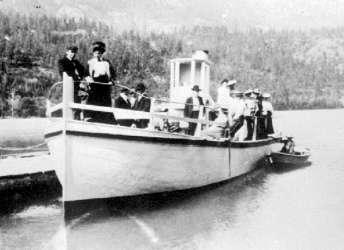
Steamboat travel on Seton and Anderson Lakes was how the Interior of British Columbia was first opened up to colonization, more famously in the Kootenay and upper and lower Fraser than through the Lillooet, although there it was crucial even though services were never as developed as they were on the Fraser or the lakes of the Kootenay or Okanagan-Shuswap.. Never as large watercraft craft as were lake and river steamers elsewhere in the province, several small steamers of reknown worked the Lakes in the decades after the 1858 Gold Rush, most of them eventually winding up on the deep bottoms of these often storm-tossed lakes. The rough open scow on the left was named the Minnie Ha-Ha, and I believe the picture in question was taken in 1862, when traffic on the lakes was winding down after the opening of the Fraser Canyon wagon road from Yale. I think it was taken in the McNeils area of the lake, about halfway between Shalalth and Lillooet, in which case the peak in the background would probably be Nosebag Mountain, just west of Mission Pass. The larger boat on the left is the SS Britannia, which ran between the Portage and the Lillooet end of the lake for several decades before finally being retired (sunk?). This picture was taken at the Seton Porgage dock, the benchland in the background being the flank of Mount Skeil. By the costume of the passengers I am guessing they are on an excursion, perhaps even tourists taking a tour of the lake's spectacular canyon-cliffs from the Lillooet end - there were few non-natives living in the Portage between the 1860s and the building of the PGE in the 1910s. If this picture is from after 1912, it is probable that they were guests of Craig Lodge or one of the other hostelries located along the newly-built rail line. The difference in eras is sharply noticeable in the gender and dress of the passengers - in the 1860s, very few white women journeyed to the goldfields, whereas the leisurely life of the "Golden Age" of the 1910s is clearly remarked upon at left. | |
| BC Archives # D-03146 |
||
| BC Archives # I-33335 (Photo: Frank Swannell) |
BC Archives # C-01329 (Photo, Unknown, 1927) |
|
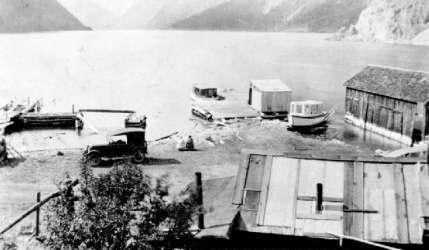
| Seton lake remains fairly busy with boat traffic to this day due to recreational craft and hydro and other service boats - and has long been reknowned for spectacular waterskiing. In the old days, though, especially before the railway, the lakes were main means of contact from the Seton and Gates and Pemberton country to the outside world, as the old route out through Douglas had fallen into disuse and there was no usable road to Newport (Squamish). During the gold rush, untold numbers of rafts and other watercraft flooded through Anderson and Seton Lakes en route to the Canyon and the Cariboo. The picture above at left is from 1909, when some of the small steamers were still operating on Seton Lake; on the farther shore one launch-craft can be seen (this may be the Britannia depicted in a closeup above), apparently attached to Craig Lodge's tourist services (or not? - | ||
| In the decades after, passenger and freight services were maintained for years by different vessels; two of these are depicted here, the Britannia and the Minnie, with the former obviously being the better class of transportation. Several - well, at least a few - vessels have sunk in the lake, including both of those shown; Seton Lake in particular is known for its savage winds and occasional bad weather. Passenger service on the lakes was discontinued with the advent of passenger services on the rail line in the early 20th Century, although various plans have been floated recently to provide water taxi service on both lakes for tourism purposes, as well as for the general benefit of the many local residents of both lakes. The dock shown is at the Lillooet end of the lake, from whence there was carriage or car service to Lillooet; the little vessel is a service boat, possibly of the hydroelectric company. | ||
|
||
|
||
|
||