 Dret
- Indeed
delate
usually means true, straight, etc. "indeed" is
elsewhere rendered as nawitka
Dret
- Indeed
delate
usually means true, straight, etc. "indeed" is
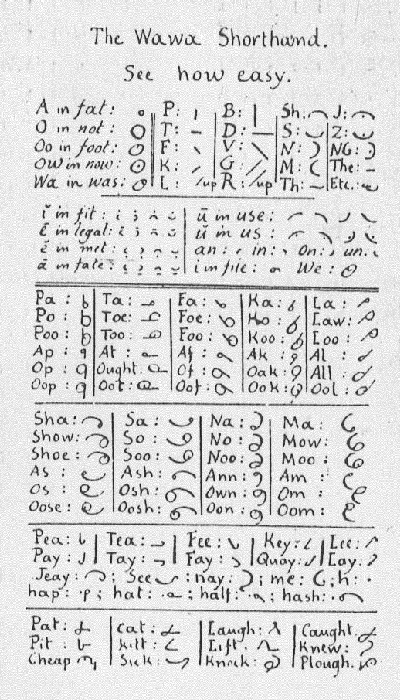
elsewhere rendered as nawitkaThe original version of this list as it appeared in Kamloops Wawa included renderings of the words given in the Duployan shorthand script developed for the Jargon by Fr. Lejeune; there were apparently at one time over 2000 people fluent in reading the Jargon in this shorthand, and many copies of the Kamloops Wawa are nearly entirely in the shorthand alone. The texts in yellow are my own additions, consisting of the usual (or alternate) spellings of the Jargon words noted, plus comments about their usual meanings and possible contexts; when necessary I have added links to appropriate pages elsewhere in this site that are pertinent to the word cited. At the bottom of the word list there is some editorializing concerning the Jargon and the Duployan shorthand that was included in the same issue of the Kamloops Wawa as the word list, and for your convenience in studying the Duployan script glyphs of each word, the table of forms and associated phonemes may be viewed by clicking here (144kb). A later revision of this page will attempt to align the glyphs according to the baseline used in the original, which is too large of a GIF to be viewed here in any legible format; many of the angle-lines shown here are below this baseline.
NB: concerning prononciation, the final
"-e"
and "-ale" on most words should be understood to be a pronounced
syllable,
rather than a modifier of the preceding vowel as it is in
English.
e.g. the word poolale here is usually given in other Jargon
lexicons
as pollalie.
Current alphabetization is based on the spellings
as transliterated by LeJeune. Later improvements to these pages
will cross-reference the Kamloops Wawa spellings with the more common
Gibbs/Shaw system, and perhaps the new phonologically-strict
orthography of the Grand Ronde Creole. Note that some words are
placed alphabetically; e.g. "ice" is under 'A" because of the opening
vowel, unlike other i-words which have "ih" at the start.
Similarly, whip and wheat are in 'h" because LeJeune transcribed them
with the whispered-h pronuncation once proper in English..
Dret
- Indeed
delate
usually means true, straight, etc. "indeed" is
elsewhere rendered as nawitka Dry
Dry Dollar The
prononciation written here is the with an initial 't', and there is no
final 'r' or 'h'
Dollar The
prononciation written here is the with an initial 't', and there is no
final 'r' or 'h'
 Taye - Chief tyee can also mean any official or person of
rank or status
Taye - Chief tyee can also mean any official or person of
rank or status
 Taham - Six
taghum, tohum, tahum
Taham - Six
taghum, tohum, tahum
 Tatilam - Ten tahtlum
 Tamanwaz - Juggler tamanass, tamahnous, tamanahwis usually translated as magic, the
supernatural, wizard, spirit, evil etc. The intent here might
be to associate the tamanass or Indian doctor (medicine man)
with mere prestidigitation, and not concede the existence or validity
of magic or non-Christian practices
Tamanwaz - Juggler tamanass, tamahnous, tamanahwis usually translated as magic, the
supernatural, wizard, spirit, evil etc. The intent here might
be to associate the tamanass or Indian doctor (medicine man)
with mere prestidigitation, and not concede the existence or validity
of magic or non-Christian practices
 Tanaz - Little tenas, tenass
also means small, child,
son,
the young of any species, etc.
Tanaz - Little tenas, tenass
also means small, child,
son,
the young of any species, etc.
 Tolo
- Win
also means to gain, to
earn, to conquer
Tolo
- Win
also means to gain, to
earn, to conquer
 Tomtom - Heart tumtum also means to think, to feel, to
believe, etc.
Tomtom - Heart tumtum also means to think, to feel, to
believe, etc.
 Tepso - Herb tupso also means grass, flowers, any plant, etc.
 Tekop
- White tkope
Tekop
- White tkope
 Teke - To like tikegh, ticky to
want, to desire, to yearn
Teke - To like tikegh, ticky to
want, to desire, to yearn
 Tiktik - Telegraph usually means a watch or a timepiece; I
have not seen this translation elsewhere
Tiktik - Telegraph usually means a watch or a timepiece; I
have not seen this translation elsewhere
 Tel - Tired till
 Telikom - Men tillikum, tillicum can mean people or a person; often used in
the context of "friend", and can occur in a plural form with "-s"
Telikom - Men tillikum, tillicum can mean people or a person; often used in
the context of "friend", and can occur in a plural form with "-s"
 Tintin - Bell also means to
ring, or any sound, or music
Tintin - Bell also means to
ring, or any sound, or music
 Tlap - Catch klap
also means to find, to arrive at
a conclusion, to remember something (i.e. to find a thought)
Tlap - Catch klap
also means to find, to arrive at
a conclusion, to remember something (i.e. to find a thought)
 Tloos
- Good kloshe, kloos has a wide
variety of other meanings in many compound forms
Tloos
- Good kloshe, kloos has a wide
variety of other meanings in many compound forms
 Tloon - Three klone
 Tlil - Black klale
 Tsee - Sweet care must be taken to distinguish this word from chee,
for new (given here as che)
Tsee - Sweet care must be taken to distinguish this word from chee,
for new (given here as che)
 Tsem
- Writing tzum can also mean spots, marks, etc.
and can be an adjective for spotted or patterned cloth, esp. calico, as
in tzum paseese
Tsem
- Writing tzum can also mean spots, marks, etc.
and can be an adjective for spotted or patterned cloth, esp. calico, as
in tzum paseese
 Tsiktsik
- Wagon chikchik
Tsiktsik
- Wagon chikchik
 Tsiltsil - Stars chilchil
 Tanke son (tahke son?) - Yesterday
tahlkie, tahlkie sun the "sun" compound specifies the daytime; tahlkie polaklie would mean yesterday evening or last night
Tanke son (tahke son?) - Yesterday
tahlkie, tahlkie sun the "sun" compound specifies the daytime; tahlkie polaklie would mean yesterday evening or last night
 Tlemenooit - To tell a lie
kliminawhit can also mean a liar; from the word klimin
or klimmin - smooth, a lie
Tlemenooit - To tell a lie
kliminawhit can also mean a liar; from the word klimin
or klimmin - smooth, a lie
 Tea
Tea
 Tomorrow
Dollar The
prononciation written here is the with an initial 't', and there is no
final 'r' or 'h'